
The promotion felt incredible for about four days. Then came the first team meeting where nobody spoke, the first time you had to tell a friend their work wasn't good enough, the first Sunday night redoing someone's deliverable at 11 p.m. because it was easier than having the conversation. And somewhere in that week: "I think I was better at my old job." You were — that's not weakness, that's arithmetic. You spent years getting excellent at a craft, then got promoted into a completely different one, on the assumption that being good at the work makes you good at leading it. It doesn't.
The scale of the problem is genuinely absurd
The Chartered Management Institute found 82% of new managers take on their first management role without any formal training, and 52% of people already in management hold no management or leadership qualification whatsoever. One in three people have left a job because of a negative work culture, half of those who say their boss is ineffective plan to quit within a year, and only 27% of workers describe their manager as highly effective. Gallup's research puts managers at accounting for at least 70% of the variance in employee engagement across business units. Translation: your team's experience of work is mostly you.
Why great performers struggle as first-time managers
The behaviours that made you a star are the exact behaviours that sink you as a manager. You were rewarded for doing it yourself — now you must get results through others. You were rewarded for being the best in the room — now your job is to make others better than you. You were rewarded for speed — now the fastest path, doing it yourself, is the most damaging one. Research on subject-matter experts turned managers finds this repeatedly: many fall into micromanaging or trying to do everything themselves, leading to burnout, and many avoid difficult conversations about team dynamics altogether.
Real-life example: Rohan, 27, was the best account manager on his team, now leading six people. He notices a junior's client email is clumsy, so he rewrites it himself — four minutes, feels efficient. He does this roughly forty times a month. By quarter's end he's exhausted, the junior hasn't improved (nobody told her what was wrong), and Rohan's quietly concluded his team is weak. None of that is true — he chose four minutes of comfort over ten minutes of coaching, forty times over.
The three conversations you're probably avoiding
- The expectations conversation. "Do a good job" is not a standard. Specific, measurable asks are.
- The feedback conversation. Feedback given within 48 hours, privately, about a specific behaviour, is almost always received well. Delayed feedback becomes resentment.
- The disagreement conversation. Silence in your meetings is not agreement — it's usually caution.
AI is about to make this harder — and more important
Gartner projects that through 2026, 20% of organisations would use AI to flatten structures, eliminating more than half of current middle-management positions. The managers who survive won't be the ones best at reporting status upwards — AI does that now. They'll be the ones who can do "human-signal management": noticing when silence means fear, when agreement is performative, when a high performer is close to burnout. A meeting summary can be automated; the courage to say "everyone's nodding, but I don't think we actually agree" cannot.
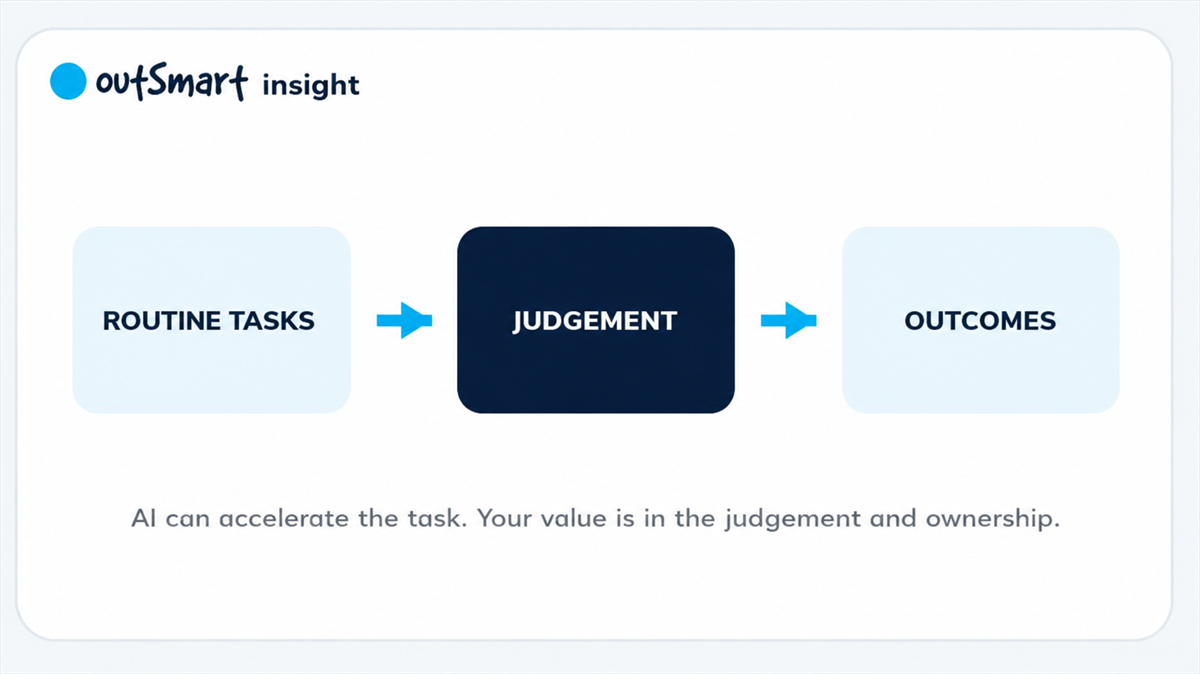
OutSmart Perspective
At OutSmart, we believe the most under-served person in the modern workplace is the first-time manager — given responsibility for other people's growth and careers, usually with a title, a raise, and zero preparation. Leadership isn't a personality you're born with; it's a set of practised behaviours: setting clear expectations, delegating without abandoning, giving feedback that lands, having the hard conversation early, and building enough self-awareness to notice your own patterns. That's coaching territory, not classroom territory — which is why our leadership work runs as cohorts and coaching rather than lectures.
What You Can Start Doing Today
- Run a "what does good look like" reset for each team member, and check whether they'd write the same three outcomes.
- Delegate one thing you're still doing yourself — hand it over with context and a deadline, and leave it alone.
- Adopt the 48-hour feedback rule: given privately, about one specific behaviour.
- Start weekly 1:1s and protect them — their agenda, never cancelled.
- Ask "what's the weakest part of this plan?" instead of "any questions?"
- Track your rescues for one week — every time you redo someone's work is your coaching debt.
- Find one mirror — a peer, mentor or coach who'll tell you the truth about how you're showing up.