There's a moment happening in offices across India right now. A 24-year-old finishes a task in twenty minutes that used to take a full afternoon. She feels brilliant. Then, three days later, her manager finds a factual error in the deck she submitted — one she'd have caught if she'd written it herself. She realises she can't fully defend her own work.
The real question isn't "will AI replace me?" — it's "is AI making me faster, or making me hollow?" Both are possible. Which one you become is a choice you're making every day, mostly without noticing.
The premium is real — and it's growing fast
Jobs requiring AI skills now carry a 56% wage premium over comparable roles that don't — up from 25% the previous year, more than double in twelve months. In India, more than 90% of employees have begun working with generative AI tools, with AI, data analytics, cloud computing and cybersecurity the most in-demand skills. If 90% of your peers already use AI, using it isn't a differentiator — it's the new baseline, like Excel in 2010. The premium goes to people who use it well, in ways that survive scrutiny.
The two kinds of AI users
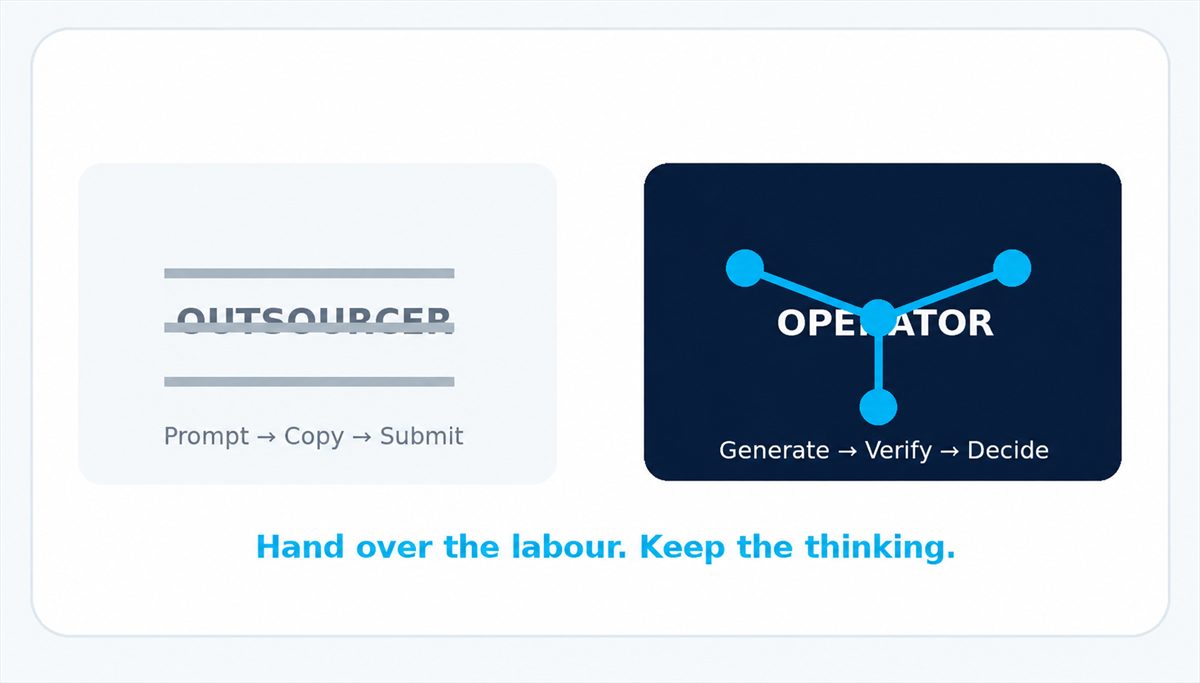
The Outsourcer hands over the thinking — prompt, copy, paste, submit. Fast on Monday, fragile on Friday. When asked "why did you recommend this?", they have no answer, because they never made the decision. The Operator hands over the labour and keeps the thinking — knows what a good output looks like, catches hallucinations, generates ten options and uses judgement to kill nine. The market pays Operators and quietly stops promoting Outsourcers, usually without ever saying why.
Real-life example: two analysts prepare a competitor summary. Analyst A pastes the AI output straight in — clean, confident, and containing a market-size figure that's two years stale. Analyst B uses AI to structure it, verifies the three numbers that matter, and adds: "Note: the widely quoted figure is from 2024; the updated number changes our pricing assumption." Analyst B gets invited to the strategy meeting. Not because of AI — because of the thirty minutes.
What AI cannot do for you
The World Economic Forum's Future of Jobs research found employers expect 39% of workers' core skills to change by 2030, with analytical thinking the number-one core skill (seven in ten companies call it essential), followed by resilience, flexibility and agility. AI is best at production — and weakest at deciding what problem is worth solving, knowing when an answer smells wrong, carrying responsibility, and reading the room. Over 80% of Gen Z say developing empathy and leadership is critical to their career progression, even while working alongside AI. The instinct is right; the follow-through — since these don't come with a certificate — is where most people fall short.
The "learning cliff" nobody warns you about
If you use AI to skip the messy, slow, frustrating phase of a skill, you never build the underlying capability. You feel productive; your output looks fine — but you've built a career on scaffolding with nothing behind it. Then you get promoted into a role where you must evaluate other people's work and make calls under ambiguity, and you can't, because evaluation requires expertise you outsourced before you had it. The fix isn't to avoid AI — that costs you the premium. The fix is deliberate: go fast on what you've already proven you can do, and go slow on purpose on what you're still learning.
OutSmart Perspective
At OutSmart, we think the AI conversation has been framed badly for young professionals. It's not a tools problem — it's a judgement and self-awareness problem wearing a tools costume. You can learn any AI tool from a free tutorial in an afternoon. What you can't learn from a tutorial is when to trust your own thinking over the machine's, how to defend a recommendation to seniors, or how to build the expertise that makes you worth consulting. Those are built the old-fashioned way: real practice, real feedback, real stakes, and a coach who tells you the truth about your blind spots.
What You Can Start Doing Today
- Run the "defend it" test: before submitting AI-assisted work, ask if you could defend every claim if challenged.
- Pick one skill to build the slow way — manually, for 30 days.
- Verify the three numbers that matter in any AI-assisted output, every time, at source.
- Use AI to widen options, not to pick one — ask for ten approaches, then reason through which nine to cut.
- Build one repeatable AI workflow for your actual weekly job, document it, share it with your team.
- Practise explaining your work to a non-expert — if they can follow it, a client can.
- Ask your manager: "Where is my judgement still weak?"