You're seven years into a career you chose at nineteen. You're competent, people rely on you — and yet there's a low hum of unease: the ground is moving, your industry looks different than it did three years ago, and the thing you're best at may not be the thing that matters next. You're not being dramatic. You're reading the data correctly, even if you've never seen it.
The number behind the unease
The World Economic Forum's Future of Jobs research, drawn from over 1,000 global employers representing more than 14 million workers, found employers expect 39% of workers' core skills to change by 2030 — down from 44% in 2023, credited partly to growing investment in continuous learning. The same research projects job disruption could affect 22% of jobs by 2030, creating around 170 million new roles while displacing 92 million. Both things are true simultaneously — this is a story about transition, not disappearance. The people who struggle most aren't the least talented; they're the ones with no system for changing.
Why "just keep learning" is useless advice
Nobody tells you what, when, or how much — so the typical response is anxiety-shopping: eleven half-finished courses and a vague guilt every Sunday. Consumption feels like progress and isn't; watching someone else solve a problem builds recognition, not capability. What separates people who adapt well isn't learning more — it's learning deliberately, in public, and in application.
The three-layer skill stack
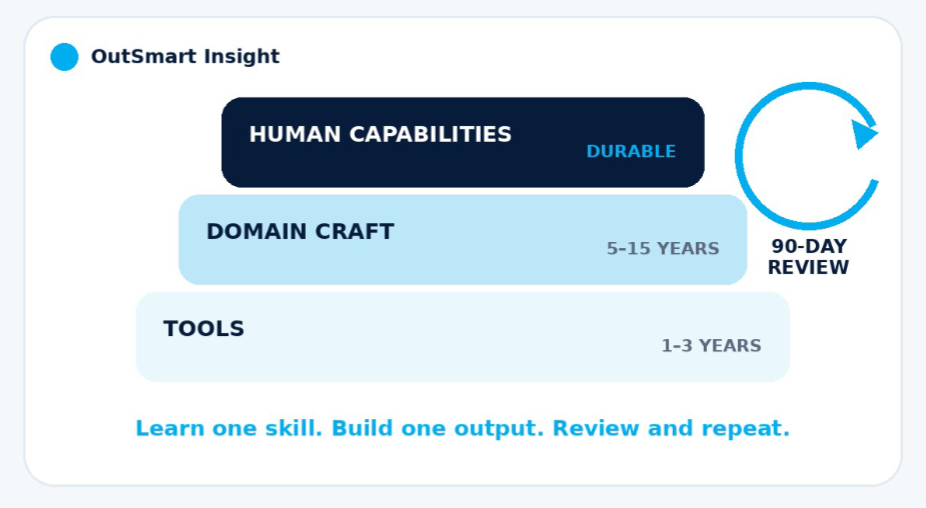
Layer 1 — Tools (expire in 1–3 years): specific software, platforms, current AI tools. High urgency, low durability — learn fast, hold lightly. Layer 2 — Domain craft (5–15 years): how your sector actually works, only built by doing the work and being wrong sometimes. Layer 3 — Human capabilities (do not expire): analytical thinking, communication, resilience, judgement, learning agility. Most people spend 90% of their energy on Layer 1 — exactly backwards. Layer 1 keeps you employed this year; Layers 2 and 3 keep you employable for thirty.
Real-life example: two professionals, same team, both eight years in. When their function starts getting automated, Person A doubles down and defends the old process. Person B spends three months learning the new system badly, volunteers to run one pilot, fails partially, and documents what she learned. Eighteen months later, Person B is leading the transition — not because she was smarter, but because she treated the change as something to practise rather than survive.
Build a personal learning system, not a wish list
One skill at a time, for one quarter — not five, one. Applied to a real output that ends with something that exists. Shared with one person who'll see it, since learning without an audience decays. Reviewed every 90 days: what did I build, what changed in my field, what's next. Four rules beat eleven courses.
OutSmart Perspective
At OutSmart, we don't think the future belongs to the most qualified — it belongs to the most adaptable. Adaptability sounds like a personality trait; it isn't. It's a set of habits: honest self-assessment, deliberate practice, seeking feedback early, and the emotional resilience to be visibly bad at something new in front of other people. That last one is the real bottleneck — most careers stall because someone couldn't tolerate being a beginner again. That's why we build around coaching and cohorts: learning alongside people at the same edge of discomfort, with a coach who reflects your patterns back to you.
What You Can Start Doing Today
- Map your three layers — tools, domain craft, human capabilities — and be honest about where you're thin.
- Pick one skill for this quarter, with a specific output by day 90.
- Cancel the guilt library — unsubscribe from courses you'll never finish.
- Learn in public — share one thing you're building each month.
- Schedule a 90-day career review with three questions: what did I build, what changed, what's next.
- Deliberately do one thing you're bad at each month, in front of someone.
- Get one outside perspective from a mentor or coach who isn't inside your company.